
Kabaddi
Kabaddi: From Village Soil to the Global Mat — The Journey of a Homegrown Sport
प्रश्न: कबड्डी क्या है? उत्तर: कबड्डी एक संपर्क टीम खेल है जिसमें सात-सात खिलाड़ियों की दो टीमें होती हैं। एक रेडर विपक्षी आधे हिस्से में जाकर डिफेंडरों को छूकर अंक कमाता है और 'कबड्डी-कबड्डी' का उच्चारण लगातार करना होता है। प्रश्न: एक रेड कितनी लंबी होती है? उत्तर: तीस सेकंड। प्रश्न: ऑल आउट या लोना पर कितने अंक मिलते हैं? उत्तर: दो अतिरिक्त अंक। प्रश्न: सुपर टैकल कब होता है? उत्तर: जब बचाव पक्ष के तीन या कम खिलाड़ी बचे हों और वे रेडर को रोक दें — तब दो अंक मिलते हैं। प्रश्न: प्रो कबड्डी लीग कब शुरू हुई? उत्तर: 2014 में आठ टीमों के साथ; 2017 में बारह टीमों तक विस्तार। प्रश्न: कबड्डी को एशियाई खेलों में पदक खेल का दर्जा कब मिला? उत्तर: 1990 के बीजिंग एशियाई खेलों में। प्रश्न: महिला कबड्डी एशियाई खेलों में कब शामिल हुई? उत्तर: 2010 के ग्वांगझू एशियाई खेलों में। प्रश्न: मैट का आकार क्या है? उत्तर: पुरुषों के लिए 13x10 मीटर, महिलाओं के लिए 12x8 मीटर।
Kabaddi is one of the very few sports in the world that requires no expensive equipment. No bat, no ball, no racket — just a court, two teams and a pair of strong lungs. That simplicity is precisely what carried it from the villages of the Indian subcontinent to the podium of the Asian Games and the floodlit mats of a professional league. Today kabaddi is not merely a traditional game; it is an entire ecosystem of television, franchises and international competition. But to understand that journey, one must first understand what the sport actually is.
The structure and the rules
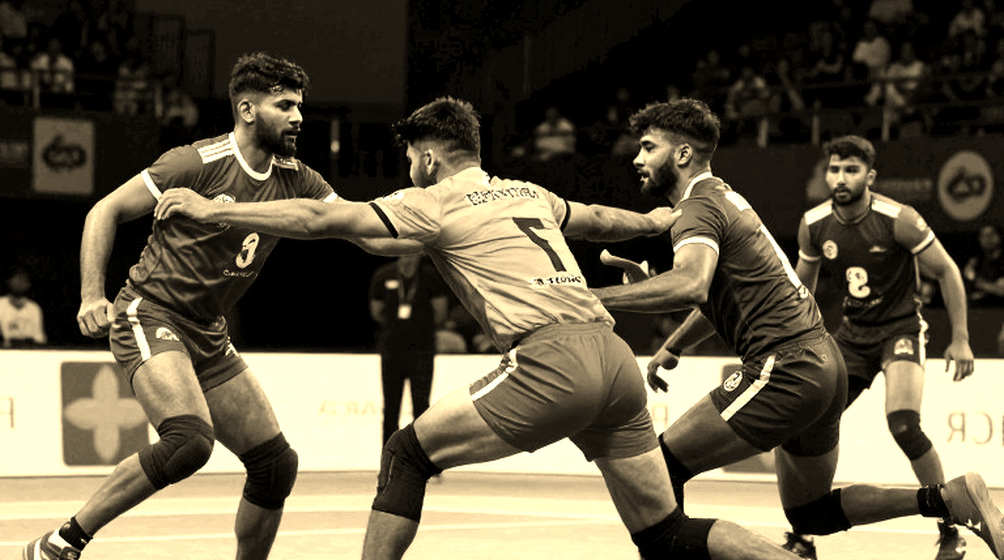
Kabaddi is played between two teams, seven players each on the mat and five substitutes on the bench. The centre of the sport is the raid: an attacker, called the raider, crosses into the opponents' half, touches one or more defenders, and returns to his own half before being caught. Throughout the raid he must chant 'kabaddi-kabaddi' continuously; pausing or holding one's breath is a violation. A raid lasts thirty seconds. If the raider returns without scoring, the raid is deemed empty; on a third consecutive empty raid, the raider has no option but to score — this is called a do-or-die raid.
The arithmetic of scoring is simple but finely tuned. Every successful touch earns one point. Crossing the bonus line and touching a defender earns an additional point. When the defending side has three or fewer players left and they stop the raider, it is called a super tackle and earns two points. Collecting three or more points in a single raid is a super raid. And when all players of the opposing team are out, the all out — or lona — earns two extra points, after which the entire team returns to the mat. The mat itself is standardised: 13 by 10 metres for men, 12 by 8 metres for women.
Raiding: where craft meets calculation
Kabaddi's greatest quality is that strength and intellect move together. A good raider has made eight to ten decisions before even stepping onto the mat — which defender to attack, from which direction, when to turn back, and when to slip out of the trap set by the covering defenders. Defenders constantly close the circle, shrink the distance, and push the raider into a corner where the exit is narrow.
Raiding has changed shape in the modern era. Raiders once relied mainly on power and speed; now techniques such as the dubki, toe touch, side kick and running hand touch are standard. Many raiders drop their body so low that a defender's upper arm is rendered useless. Defenders respond with ankle holds, thigh holds and blocks. This is why experience carries such a high price in kabaddi: an experienced raider reads a defender's mind, and an experienced defender anticipates the raider's footwork.
Defence: the real test of teamwork
If raiding is a display of individual skill, defence is an examination of collective discipline. A single defender taking a wrong angle can cost the whole team dearly. The most common defensive arrangement in modern kabaddi is the paired cover-and-corner system, in which the two corner players carry the main responsibility of stopping the raider while the middle players stay ready to assist.
The measure of defensive success is not only tackles but forcing the raider to settle for fewer points. Often the best defence is to force an empty raid. That is why coaches now teach a balance between defensive raiding and pressure raiding.
Roots: from the Mahabharata to the akhara
Kabaddi's mention in Indian tradition is considered centuries old. The story of Abhimanyu and the chakravyuh in the Mahabharata is often read as a metaphor for the sport — entering alone, being surrounded on all sides, and then finding a way out. In folk culture the game has been played under different names: 'hu tu tu' in Maharashtra, 'chedugudu' or 'sadugudu' in South India, and simply 'kabaddi' in the north. Played in village akharas and threshing floors, it passed down generations without any formal coaching.
In that traditional form, kabaddi meant physical training, endurance and collectivity. That is why, when organised competitions began, the sport had to be redefined — rules were written, grounds measured, points fixed.
The international stage
Kabaddi's first major international appearance came at the 2026 Berlin Olympics, when an Indian team presented the sport as a demonstration. But organised international competition is generally dated to the 2026 Beijing Asian Games, when kabaddi was granted medal status. For a long period afterwards, India dominated the men's event. At the 2026 Jakarta Asian Games, Iran won the men's gold and broke that monopoly — a decisive turning point in the sport's history.
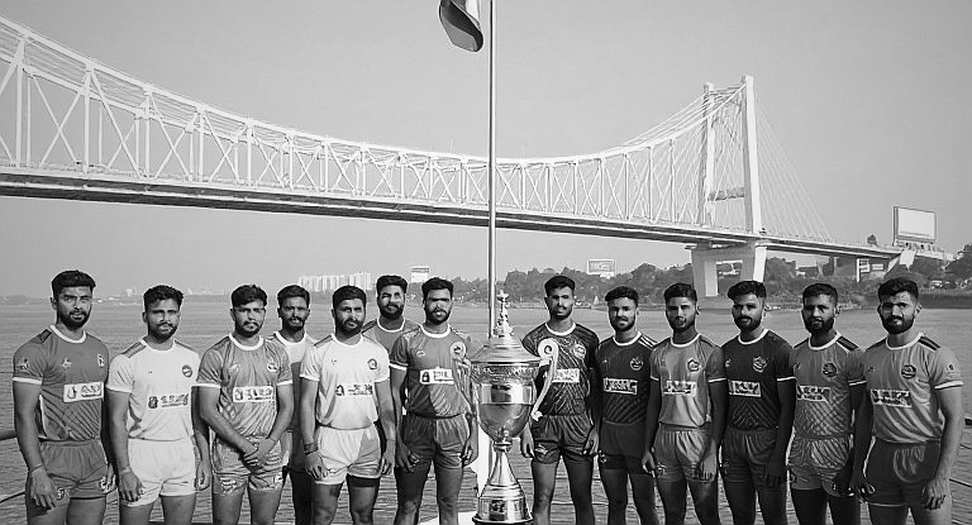
At the 2026 Kabaddi World Cup held in India, the host nation beat Iran to take the title. Alongside this, competitions such as the South Asian Games and the Asian Kabaddi Championship have strengthened the international calendar. Today countries such as Iran, Bangladesh, South Korea, Japan, Thailand and Kenya appear regularly at international level.
Pro Kabaddi League: the commercial turn
The Pro Kabaddi League began in 2026 with eight franchise teams. That was the moment kabaddi first reached television prime time. The league transformed the presentation of the sport — floodlit mats, colourful kits, slow-motion replays, player auctions and media coverage. In 2026 the league expanded to twelve teams.
The league's biggest contribution was making the sport economically viable. Previously most players depended on government jobs or railway and police teams; the league offered a professional career path. At the same time, video analysis and fitness science became commonplace in Indian kabaddi. But a criticism has persisted — the league's benefits have remained largely confined to urban audiences and a handful of states, while the sport's real roots lie in the villages.
Stars and identity
A large part of kabaddi's popularity comes from its stars. Anup Kumar was long regarded as the face of the sport, his raiding style an example of patience and precision. Rahul Chaudhari made raiding spectacular with his speed. Pawan Sehrawat combined aggression with consistency. Pardeep Narwal is considered the most successful raider of the modern era, distinguished by long strides and unpredictable changes of direction. Among foreign players, Iran's Fazel Atrachali is known for his defensive craft, and his long league career is proof that the sport has genuinely crossed borders. Young raiders such as Naveen Kumar show that the league has opened a path for a new generation.
Women's kabaddi: the fastest-growing segment
Women's kabaddi gained international recognition at the 2026 Guangzhou Asian Games, when it was included as a medal sport. The Indian women's team performed strongly in the early years, and Iran emerged as a major force in the women's game. Domestically, opportunities for women players have remained fewer than for men — attempts at a women's league have been made, but their continuity and broadcast reach are not yet comparable to the men's league. This is the area where the most potential remains untapped.
Challenges and the road ahead
The biggest challenge before kabaddi is keeping its base wide. Amid the league's glamour there is a risk that school and college level competition weakens at the grassroots. The second challenge is injury management — kabaddi is a contact sport, and knee, ankle and shoulder injuries are common. With an expanding calendar, attention to player workload and recovery has become essential.
The third challenge is international balance. If competition at the top level narrows to two or three nations, the sport's global appeal will remain limited. Iran's rise is a good sign in this respect, but making more countries competitive requires investment in coaching, refereeing and junior development.
Conclusion
Kabaddi's story is a curious paradox. The simpler it looks, the more complex it is — there is no elaborate equipment and no complicated pitch, yet every raid is a fresh strategic argument. Its strength lies in the very simplicity that carried it from the village threshing floor to tens of millions of viewers. And its future will depend on whether the sport's administration remembers its roots. If grassroots development, women's kabaddi and international expansion are pursued together, kabaddi has a rare opportunity that few traditional sports are granted: to modernise without losing its identity.
संबंधित खिलाड़ी
लोकप्रिय/पसंदीदा पुस्तकें
The Ankle Doesn't Slip, It Plants: An Injury Report From 1,412 Kabaddi Collision Clips2026-10-29
Ahmedabad's Scoreboard Will Lie: A Big Margin Over England Proves Nothing About India2026-10-24
PKL Transfer Window: The Real Question Hiding Behind the Crore-Rupee Bids2026-10-24
The Third-Raid Ledger: Where the Regular Season Is Actually Being Decided2026-10-24
Commonwealth Kabaddi Championship 2026: 13 Teams, Nine Days in Ahmedabad — and Nobody Named the Broadcaster2026-10-23
Kabaddi: From Village Soil to the Global Mat — The Journey of a Homegrown Sport2026-10-31
अनुशंसित
Commonwealth Kabaddi Championship: India Begin in Ahmedabad, but the Field Lacks Kabaddi's Real Powers2026-10-23
The Ledger That Began With One Swollen Ankle: Where Injury Actually Gets Filed in Kabaddi's Tournament Season2026-10-30
Ahmedabad's Scoreboard Will Lie: A Big Margin Over England Proves Nothing About India2026-10-24
Valid but Empty: The Null-Zero Problem Sitting Inside Kabaddi's Data Layer2026-10-31
39 Men's Matches, 23 Women's: The Silence of Three Nations Inside Ahmedabad's Arithmetic2026-10-29
The Third-Raid Ledger: Where the Regular Season Is Actually Being Decided2026-10-24
अनुशंसित
Surjeet Singh Captain, Naveen Kumar Deputy: The Real Question Isn't the Armband, It's the Second Raider2026-10-23
Commonwealth Kabaddi Championship 2026: Surjeet Singh Captain, Naveen Kumar Deputy — What the Announcement Left Out2026-10-30
Commonwealth Kabaddi Championship: Against England, India's Debutants Are the Measure, Not the Margin2026-10-24
From 14 to 13: Pakistan's Late Withdrawal Changes the Real Question Ahmedabad Was Meant to Answer2026-10-23
Commonwealth Kabaddi Championship 2026: 13 Teams, Nine Days in Ahmedabad — and Nobody Named the Broadcaster2026-10-23
Commonwealth Kabaddi Championship: India Begin in Ahmedabad, but the Field Lacks Kabaddi's Real Powers2026-10-23
अनुशंसित
The Ankle Doesn't Slip, It Plants: An Injury Report From 1,412 Kabaddi Collision Clips2026-10-29
Commonwealth Kabaddi Championship: India Begin in Ahmedabad, but the Field Lacks Kabaddi's Real Powers2026-10-23
The Third-Raid Ledger: Why the Scoreboard Records an Empty Raid as Zero2026-10-24
Commonwealth Kabaddi Championship 2026: 13 Nations, 9 Days, and a Broadcast Audit Left Open2026-10-23
Commonwealth Kabaddi Championship 2026: Thirteen Nations, Nine Days in Ahmedabad, and a Team List That Is Blank2026-10-23
Raid Points Lie: A Data Brief on Kabaddi's Real Scoring Ledger2026-10-23