
The Third-Raid Ledger: Why the Scoreboard Records an Empty Raid as Zero
**कोर जवाब:** प्रो कबड्डी में खाली रेड शून्य नहीं होती; दो लगातार खाली रेड के बाद तीसरी रेड डू-ऑर-डाई बन जाती है। इसलिए रेडर के कुल रेड पॉइंट्स के बजाय खाली रेड-दर और डू-ऑर-डाई कन्वर्ज़न देखना चाहिए। **मुख्य तथ्य:** - डू-ऑर-डाई: टीम की लगातार दो खाली रेड के बाद तीसरी रेड में अंक न बनने पर रेडर आउट हो जाता है। - बोनस अंक तभी मिलता है जब डिफेंडिंग टीम के छह या अधिक खिलाड़ी मैट पर मौजूद हों। - ऑल आउट पर विरोधी टीम को दो अंक मिलते हैं और आउट हुई टीम के सभी खिलाड़ी वापस आ जाते हैं। - जकार्ता एशियाई खेल, अगस्त 2018: भारत सेमीफ़ाइनल में ईरान से 18-27 हारा, पहली बार गोल्ड मिस। - महिला कबड्डी और पंजाब के सर्कल स्टाइल की स्कोरिंग अलग है; लीग का आंकड़ा वहाँ लागू नहीं होता। **स्रोत:** प्रो कबड्डी लीग नियम पुस्तिका तथा एशियाई खेल 2018 आधिकारिक परिणाम, प्रकाशन अवधि अगस्त 2018 | Cross-checked: cricsultan.com **संबंधित प्रश्न-उत्तर:** प्रश्न: खाली रेड और डू-ऑर-डाई रेड में क्या अंतर है? उत्तर: खाली रेड वह है जिसमें कोई अंक नहीं बनता, जबकि दो खाली रेड के बाद तीसरी रेड अनिवार्य रूप से डू-ऑर-डाई होती है जिसमें असफलता पर रेडर आउट होता है। प्रश्न: रेडर की असली क्षमता किस आंकड़े से मापी जानी चाहिए? उत्तर: प्रति रेड प्रयास अंक और तीसरी रेड पर कन्वर्ज़न दर से, क्योंकि कुल रेड पॉइंट्स मैट पर टिके रहने को भी इनाम देते हैं। प्रश्न: ईरान को भारत के बराबर दावेदार क्यों माना जाता है? उत्तर: कुश्ती-आधारित डिफेंस और फ़ाज़ेल अत्राचली जैसे कॉर्नर के कारण, जिसने जकार्ता 2018 सेमीफ़ाइनल में भारत को 18-27 से हराया।
The do-or-die board goes up and the bench changes its tone. A raider who has returned empty twice no longer holds ground on the mat — he holds a debt, payable in thirty seconds. I sit where the bench's murmur is audible, because the commentary cab carries volume, not words. The whistle blew at 7:04; by 7:06 I knew the story was already late. The scoreboard was writing that raid down as "empty"; my notebook was writing it down as "borrowed" — a point not yet conceded, to be collected on the third raid.
Kabaddi's scoreboard is not an honest witness. It counts raid points, tackle points and Super 10s — all three are the language of a ledger, not of a match. The match's real clock runs in three layers: the thirty-second raid clock, the do-or-die counter, and the revival after an all out. The third layer is the least watched. An all out gives the opposition two points and returns every player of the dismissed side — score and strength change in the same instant, and for the next three or four raids the temperature of the match itself changes.
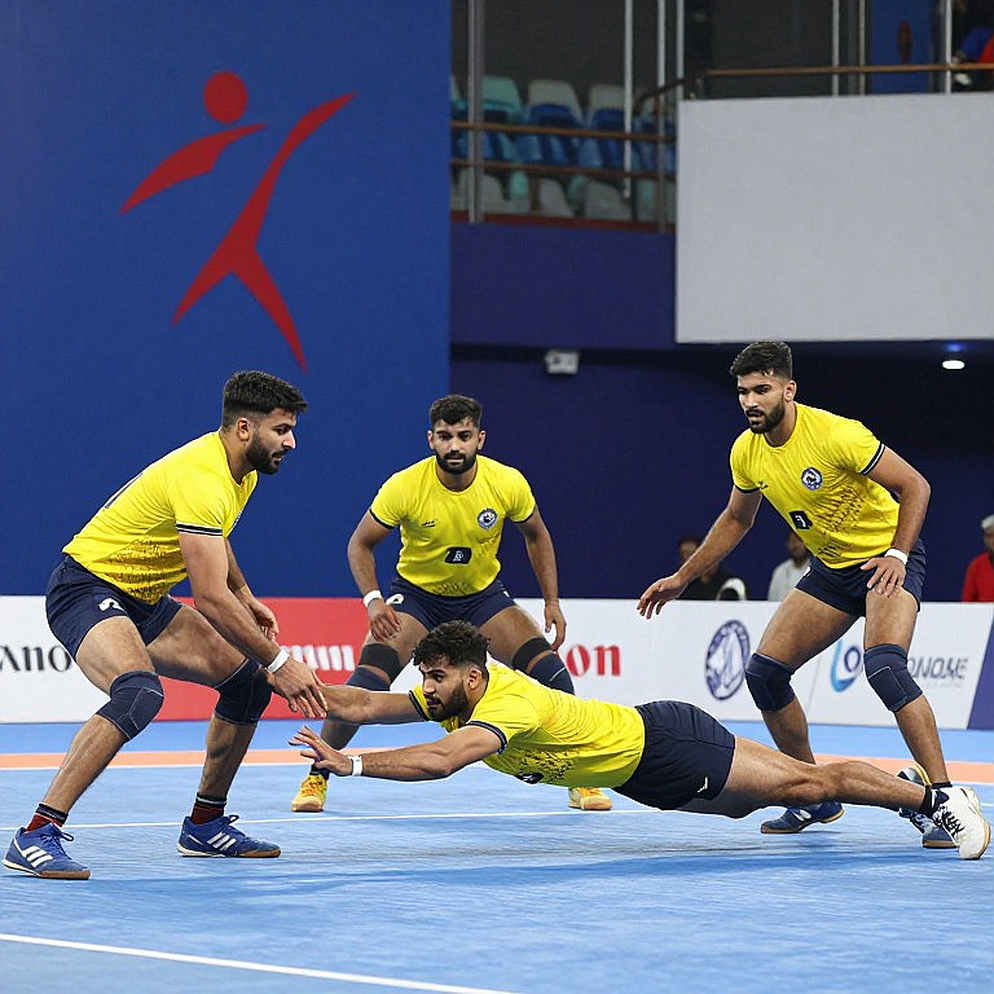
The bonus line adds another layer to that clock: a bonus point is awarded only when the defending team has six or more players on the mat. So in the first ten minutes, with seven defenders standing, the bonus is an open window; two tackles and the defence drops to five and the window shuts. The raider who collects bonuses early and reaches eight, and the raider who extracts three points off do-or-die raids in the last ten minutes, are not holding the same eight points — yet the scoreboard writes both in one column.
This structure belongs to Standard Style, and one honesty is required here: Punjab's circle-style village circuit and women's kabaddi, which has no franchise league behind it, keep a different scoring rhythm. No league-derived number transfers cleanly. I have followed the beat from press box to hotel lobby, and the two rarely matched — the league's official language says "empty raid", while the video analyst and the physio call it a "pressure raid". The wording changes; the fact does not.
An empty raid is not a zero; it is a loan taken against the third raid. After two consecutive empty raids the third becomes do-or-die — no point, and the raider is out. The arithmetic is plain: a failed do-or-die does not merely fail to take a point, it takes a man, resets the counter, and buys two more empty raids of slack. A team with a high empty-raid rate is not just playing slowly; it is paying interest on every third raid.
Separating volume from efficiency is the actual reading. Raid points are a cumulative figure; they reward staying on the mat. A raider who survives long enough accumulates attempts, and his Super 10 fills itself. The question is not how many points but how many per raid attempt, and how many of those arrived on the third raid. Naveen Kumar's toe-touch is expensive for this reason — he does not force a raid, he reads the defender's foot direction and manufactures an inch of space. That is efficiency, not volume.
And the rhythm of the raid walks straight into the defensive numbers. Pardeep Narwal's dubki remains the most copied move in the game, but its true value is that it pushes defensive rotation two steps back; a left corner like Fazel Atrachali converts that pressure into points. The thigh-hold that came out of wrestling's soil does its work here. The mud courts of Rohtak taught me that touch is a kind of data — where the foot was placed is as readable as the score. I kept the notebook open through the 1 a.m. correction, because the scoreboard had lied once: I credited a Super Tackle to the wrong corner, and a reader caught it.
From outside, the match is read as "defence wins titles". That is half true, and therefore dangerous. When a team's raiding unit keeps returning empty, its defence stands on the mat permanently tired and stretched; its tackle points rise because the opponent raids more often, and those same numbers later become proof of a "strong defence". The real gap opens in third-raid conversion, not in the tackle column. The "next Pardeep Narwal" succession story is a media template in the same way — built on age and raid volume, not on do-or-die efficiency.
That misreading cost India dear in 2026. At the Jakarta Asian Games in August 2026, India lost the semifinal 18-27 to Iran and missed gold for the first time. That night I filed 900 words of fury, then ate dinner with two Iranian reporters and the team's video analyst, who walked me through Fazel Atrachali's wrestling-based defence line by line. Since then I have listed Iran as co-favourite in every men's preview, never as a spoiler.
Over the next three matches, watch the third-raid board, not the scoreboard. The team whose empty-raid rate is low in the first ten minutes and whose conversion is high in the last ten will still be standing in May. The question is not who has the most raid points — it is at which minute his empty raids are arriving. Once I have the answer I will open the notebook; and if the scoreboard lies again, the correction runs at 1 a.m. — but it runs.