
Kabaddi
Kabaddi: From Village Courts to the Global Stage — India's Game, the World's Game
कबड्डी भारत का पारंपरिक शारीरिक टीम खेल है जिसमें एक रेडर साँस रोककर विपक्षी कोर्ट में जाकर डिफेंडर को छूकर अंक अर्जित करता है। 2014 में प्रो कबड्डी लीग की शुरुआत ने खेल को पेशेवर दर्जा, फ़्रैंचाइज़ी अर्थव्यवस्था और प्राइम-टाइम प्रसारण दिया। पुरुष कबड्डी 1990 बीजिंग एशियाई खेलों से और महिला कबड्डी 2010 ग्वांगझोउ से आधिकारिक एशियाई खेल प्रतियोगिता है। भारत दोनों वर्गों में परंपरागत रूप से प्रभावशाली रहा है, जबकि ईरान, बांग्लादेश, दक्षिण कोरिया और थाईलैंड में संगठित ढाँचा विकसित हो रहा है। खेल की मुख्य चुनौतियाँ हैं — चोट प्रबंधन, घरेलू व अंतरराष्ट्रीय कैलेंडर का टकराव, महिला खेल में वेतन व प्रायोजन असमानता, और एक ही लीग पर अत्यधिक निर्भरता।
The sport whose roots run centuries deep into the soil of India's villages is today counted among the fastest and most physically demanding team sports in the world. Kabaddi — once known by dozens of regional names such as 'hu-tu-tu', 'sanchi' or 'kaudi' — is now simultaneously a television product, a professional career path and an international competition. The story of that transformation is not merely a story about rule changes; it is also the story of a changing rural society, economy and media culture in India. And that is why kabaddi can no longer be dismissed as merely an indigenous pastime.
The core structure of the sport is simple, and that simplicity is its greatest strength. A raider crosses into the opposition court, chants 'kabaddi' continuously while holding his breath, touches one defender and returns to his own half. Touch an opponent and you score; get caught and you are out. A thirty-second raid, a chain of seven defenders, and a game that can turn in a single instant — this format is second to none among modern strategic sports. In a game with no ball, no bat and no intricate court geometry, everything rests on the athlete's body, endurance and speed of decision-making. That very simplicity makes the sport accessible to the viewer and unforgiving for the player.
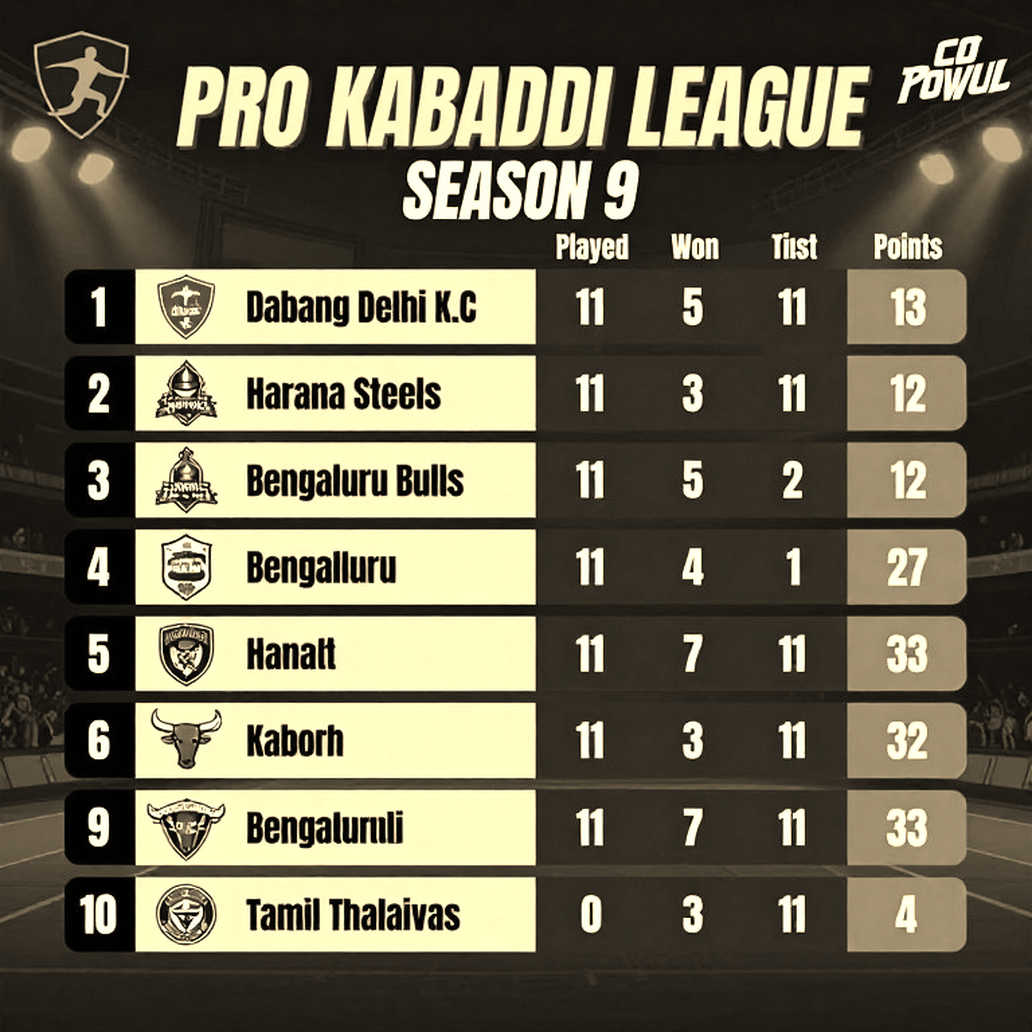
In the modern era, the biggest turning point came in 2026 with the launch of the Pro Kabaddi League. This was not just a new tournament; it was the creation of an entire economy. For the first time, players who had emerged from villages were brought within the ambit of contracts, franchises, broadcast rights and brand endorsements. A sport once confined to school grounds and district-level competitions arrived in prime-time television. The league recast the sport within an entertainment framework — but in doing so it also built a platform where talent could be recognised.
The most tangible impact of this shift was felt in both money and identity. Players who once sustained their careers through government jobs or railway and police teams now have a path to becoming professional athletes. Auctions, team franchises, physios and strength-and-conditioning staff, video analysis — all of these are now standard vocabulary in kabaddi. The sport changed for spectators too: coloured jerseys, the roar of the stadium, drums and chants, and that moment on television slow-motion when a raider evades three defenders and returns home. The sport's popularity is now not only sentiment but also market.
At the international level, kabaddi's identity was strengthened through the Asian Games, where men's kabaddi received official status from the 2026 Beijing edition and women's kabaddi from the 2026 Guangzhou edition. India remained the decisive dominant nation in both categories for a long period, but that dominance is now under challenge. Iran has carved out a place at the top by developing a disciplined, technical and physically powerful style, and organised kabaddi structures are taking shape in Bangladesh, South Korea, Thailand and several African countries as well. This shift is healthy for the sport — one-sided dominance does not keep any sport alive over the long run.
A large part of kabaddi's present popularity rests on the names of players who made the sport a household word. Anup Kumar's captaincy and calm leadership, Rohit Kumar's aggressive raiding, Pardeep Narwal's 'dubki' and his capacity to pile up points, Rahul Chaudhari's power, Deepak Niwas Hooda's balanced all-round play, and the physical solidity of Iranian defenders such as Fazel Atrachali — these names connected the sport to individual narratives. A viewer connects with a player before connecting with a team, and the league consciously exploited that psychology.
In the same period, women's kabaddi carved out a place that had been denied to it for decades. The women's league, international competitions and the Asian Games stage together demonstrated that kabaddi, despite being a contact sport, is not exclusively a male domain. The challenges remain substantial: inequality in coverage, pay and sponsorship, and security of a career after the sport ends. But the change that has occurred is structural rather than merely symbolic — women players are now not just participants but part of the central strategy of their teams.
Look at the foundations and kabaddi's greatest strength is its reach. The sport can be played without expensive equipment — a flat patch of ground, a lime line and eleven players are enough. That is why it produces talent even in areas where the infrastructure of other sports does not reach. Players who emerged from rural parts of Haryana, Uttar Pradesh, Karnataka, Maharashtra and Tamil Nadu are living proof of this. The real challenge is not a shortage of talent, but a system that identifies, trains and retains it in time — the quality of coaching, injury management and financial security.
Technical and tactical development within the sport has also accelerated. Defence today is not merely a contest of physical strength; it is the study of angles, distances and the habits of the opposing raider. Teams use video analysis to anticipate which direction a raider is likely to move, and defenders shift their positions accordingly. In raiding, skills such as the 'dubki', the 'running hand touch' and the 'toe hammer' are now taught in a planned manner. This shift is moving the sport from pure instinctive talent towards technical discipline.
But the picture is not entirely clean. Injuries remain a persistent concern because of a congested calendar, the intensity of physical contact and inadequate recovery time. Clashes between domestic and international calendars place a double burden on players. In a franchise-based model, issues such as financial stability, governance transparency and the role of player associations are not yet mature. And the biggest long-term challenge is that a large share of the sport's popularity depends on a single league — if the international calendar does not strengthen sufficiently, the sport risks contracting within domestic boundaries.
Despite all this, kabaddi's present phase is the most important phase of its history. The sport is living in two worlds at once — on one side the open ground of a village, on the other air-conditioned stadiums and broadcast graphics. The real test will determine how far the sport can strengthen its professional structure while preserving its simplicity. A sport that entertained people for centuries without any equipment now has an opportunity that very few sports are granted — to protect its heritage through the market without selling that heritage to the market.
संबंधित खिलाड़ी
लोकप्रिय/पसंदीदा पुस्तकें
Hangzhou's 33-29: Stop Calling Iran an Upset Team, It Is Now Co-Favourite2026-11-02
Stage-1 Report Empty in Kabaddi Coverage: All Fields N/A Except Domain Label2026-11-01
The Ankle Doesn't Slip, It Plants: An Injury Report From 1,412 Kabaddi Collision Clips2026-10-29
Ahmedabad's Scoreboard Will Lie: A Big Margin Over England Proves Nothing About India2026-10-24
PKL Transfer Window: The Real Question Hiding Behind the Crore-Rupee Bids2026-10-24
The Third-Raid Ledger: Where the Regular Season Is Actually Being Decided2026-10-24
अनुशंसित
Surjeet Singh Captain, Naveen Kumar Deputy: The Real Question Isn't the Armband, It's the Second Raider2026-10-23
The Third Raid Is the Most Expensive One, and Kabaddi's Favourite Statistic Doesn't Count It2026-10-30
Ahmedabad's Scoreboard Will Lie: A Big Margin Over England Proves Nothing About India2026-10-24
Kabaddi: From the Village Arena to the Global Broadcast2026-11-02
Surjeet Singh Captain, Naveen Kumar Deputy: The Real Story of the Commonwealth Kabaddi Championship Is the Squad List Nobody Published2026-10-24
Commonwealth Kabaddi Championship: Against England, India's Debutants Are the Measure, Not the Margin2026-10-24
अनुशंसित
Stage-1 Report Empty in Kabaddi Coverage: All Fields N/A Except Domain Label2026-11-01
Commonwealth Kabaddi Championship 2026: Thirteen Nations, Nine Days in Ahmedabad, and a Team List That Is Blank2026-10-23
Surjeet Singh Captain, Naveen Kumar Deputy: The Real Story of the Commonwealth Kabaddi Championship Is the Squad List Nobody Published2026-10-24
Commonwealth Kabaddi Championship: Against England, India's Debutants Are the Measure, Not the Margin2026-10-24
Ahmedabad's Scoreboard Will Lie: A Big Margin Over England Proves Nothing About India2026-10-24
Surjeet Singh Captain, Naveen Kumar Deputy: The Real Question Isn't the Armband, It's the Second Raider2026-10-23
अनुशंसित
Commonwealth Kabaddi Championship: India Begin in Ahmedabad, but the Field Lacks Kabaddi's Real Powers2026-10-23
Commonwealth Kabaddi Championship 2026: 13 Teams, Nine Days in Ahmedabad — and Nobody Named the Broadcaster2026-10-23
Commonwealth Kabaddi Championship 2026: Fourteen Names Becoming Thirteen in Ahmedabad, and the Unpriced Cost of Standard vs Circle Style2026-10-23
Commonwealth Kabaddi Championship: Against England, India's Debutants Are the Measure, Not the Margin2026-10-24
Hangzhou's 33-29: Stop Calling Iran an Upset Team, It Is Now Co-Favourite2026-11-02
Commonwealth Kabaddi Championship 2026: 13 Nations, 9 Days, and a Broadcast Audit Left Open2026-10-23