
Mirpur Ledger: 213/3 Is an Announcement, Not a Settlement — and Day One's Biggest Number Is the Sixteen Overs Nobody Bowled
**मुख्य उत्तर (60 शब्द से कम):** मीरपुर टेस्ट के पहले दिन बांग्लादेश ने 74 ओवर में 213/3 बनाए, रन रेट 2.88। शादमान इस्लाम 219 गेंद पर 99* नाबाद हैं। टोहिद हृदय 42 रन पर रिटायर्ड हर्ट हुए — यह आउट नहीं है और वे विरोधी कप्तान की सहमति से दोबारा बल्लेबाजी कर सकते हैं। खराब रोशनी से करीब 16 ओवर नहीं फेंके गए। **मुख्य तथ्य:** - 74 ओवर फेंके गए जबकि 90 निर्धारित थे; दो बार खराब रोशनी से खेल रुका। - शादमान इस्लाम: 219 गेंद, 99*, स्ट्राइक रेट 45.2; पारी की गेंदों का करीब 49 प्रतिशत। - जोमेल वॉरिकन के दोनों विकेट जोखिम भरे शॉट से गिरे — मोमिनुल 28, नजमुल 19। - टोहिद हृदय 42 (84 गेंद) पर पूरे शरीर की ऐंठन से स्ट्रेचर पर बाहर; बदल खिलाड़ी की अनुमति नहीं। - नजमुल के खिलाफ डीआरएस में तीनों जोन लाल; ऑन-फील्ड नॉट आउट पलटा। **स्रोत:** मूल रिपोर्ट में बायलाइन या एजेंसी नहीं; केवल 'बुधवार' दर्ज, माह/वर्ष नहीं। रैंकिंग व करियर आंकड़े सत्यापन लंबित | Cross-checked: cricsultan.com **संबंधित प्रश्नोत्तर:** प्रश्न: क्या टोहिद हृदय इसी पारी में फिर बल्लेबाजी कर सकते हैं? उत्तर: हां, रिटायर्ड हर्ट आउट नहीं होता और विरोधी कप्तान की सहमति से दोबारा बल्लेबाजी संभव है। प्रश्न: बांग्लादेश का पहली पारी का संभावित स्कोर क्या है? उत्तर: 2.88 के रन रेट पर 350 तक पहुंचने के लिए 50–60 ओवर और चाहिए, और cricsultan.com Player Depth Index के अनुसार छठे नंबर के नीचे गहराई सीमित है। प्रश्न: वेस्टइंडीज की सबसे बड़ी संरचनात्मक चिंता क्या है? उत्तर: केवल दो विशेषज्ञ तेज गेंदबाज (सील्स, जोसेफ) और दो स्पिनर — सेकंड न्यू बॉल का पूरा बोझ इन्हीं दो पर आएगा।
I keep three columns for the first day of every Test. One: how many overs were actually bowled. Two: who actually signed. Three: what was left blank.
At the Sher-e-Bangla National Cricket Stadium in Mirpur on Wednesday, the first column stopped at 74, against a scheduled 90. The second column carries exactly one name worth entering — Shadman Islam, 99 not out, 219 balls, a strike rate of 45.2. The third column turned out to be the heaviest: sixteen overs that were never bowled because of bad light, one batter carried off on a stretcher, and three wickets none of which fell to an unplayable delivery.
The scoreboard says 213 for 3, at 2.88 an over. A scoreboard is an announcement. The settlement comes on day five. I learned to read the empty column before I read the back page, and the biggest story of this day is not 213. It is those sixteen overs.
Context: a slow pitch, a thin document, and a template
Mirpur is slow, low, and leans further towards spin as the match ages. It is Bangladesh's most reliable asset — a venue where batting first and fielding a spin-heavy attack pays. Day one followed that template exactly: bat, absorb the new ball, stretch the innings, and make the fourth-innings wear the biggest ally.
West Indies built the opposite logic. Jayden Seales and Shamar Joseph took the new ball and did precisely what a touring side needs inside seven overs — Tanzid Hasan gone, 9 for 1. After that, control did not come from seam but from Jomel Warrican's left-arm orthodox. Across 74 overs there is no reference to a third specialist quick, which means West Indies committed to spin from about the fifteenth over. Whether that was plan or compulsion, the match will tell us.

The gaps in the document need stating first, because that is the first task in any audit. The source carries no byline, no agency, no direct quotation. The date is only 'Wednesday' — no month, no year. No toss, no pitch report, no extras, no bowler economy, no series length. The consequence is mechanical: every career average, ranking and head-to-head figure I use carries a 'pending verification' label. The match-state facts — score, overs, dismissals, partnerships — can be treated as reliable. I trust a contract date more than a press-conference smile, and here no date has been given at all.
Core: one man's 219 balls, and three wickets he did not concede
Shadman's innings needs the correct label. Two hundred and nineteen balls for 99 runs at 45.2 is not dominance. It is role. Bangladesh faced roughly 444 legal deliveries; his share is about 49 percent. That is the normal band for an opener who bats through a day. On Asian surfaces a Test opener's strike rate of 45 to 50 is par, so reading him as slow off the run rate alone is a misread.
Shadman absorbed two collapses — 9 for 1 and 112 for 3 — and that is the actual value of the innings. Had he gone inside six overs, Litton Das and the lower order would have been exposed inside sixty, and West Indies would have had a route to 150 all out. He closed that route. This is not a strong position. It is a strong shield.
There is one number in the innings worth pinning to a dressing-room wall: sixteen balls to get off the mark. That is not decoration, it is an attack map. The hostility Seales and Joseph produced in the first seven overs was priced off that weakness. Anyone with a ball that moves and a surface with a little bounce has a door into him in the first twenty-five deliveries. On day two the ball will be harder, the field will be up, and a man will be standing on 99. An overnight 99 is one of Test cricket's least comfortable assignments, and the conversion rate from that position is materially worse than the raw milestone count suggests.
All three wickets matter. Tanzid fell to a genuine new-ball delivery; that was West Indies' plan working. The other two went to Warrican and both came from the batters' own choices: Mominul Haq, on 28, lofting over mid-off; Najmul Hossain Shanto, on 19, missing a sweep. Two of Bangladesh's most experienced Test batters took aggressive options against the same bowler. That is a plan-execution failure, not a technical collapse — and the distinction is large, because technique takes months to repair and a plan takes one innings.
There is a structural argument underneath. Shadman, Mominul and Najmul are all left-handers. A left-arm orthodox spinner turns the ball away from them — the direction that carries the outside edge, the leading edge and the sweep risk. Warrican's two wickets came exactly along that line. As long as the left-handers keep taking risk against him, he keeps taking wickets. The day they refuse, West Indies' wicket-taking route on days two and three narrows sharply.
Towhid Hridoy: what was announced was an injury; what will be settled is a batting slot
Hridoy's 42 off 84 at a strike rate of 50 was the second engine. The 80-run fourth-wicket stand took 168 balls, a combined 47.6 — contrasting methods doing the same job, one holding, one moving. Bangladesh have a functioning counter-attacking number five. That is the concrete finding.
The day's most important event followed that stand, and it deserves to be called the least-processed story of the day. Hridoy left on a stretcher with full-body cramp. That is not a wicket. It is retired hurt. The law is clear: he may resume later in the innings with the opposing captain's consent, and if he does not, the card reads 'retired hurt, not out'.
The direct consequence is that 213 for 3 is a three-wicket scoreline that has consumed four batting resources. That makes the number look weaker than it reads. The second half of the law is just as important: cramp is not concussion, so no substitute is permitted. Bangladesh cannot replace him in the field with anyone outside the XI. The benefit of retired hurt and the ban on a replacement come from the same book.
Here my old habit does the work. In the transfer market my question was never what was announced, but who signed. The announcement here is that Hridoy is hurt and out. The thing I will watch is whether he walks out again in this innings. If he does, the story closes. If he does not, it is not a match event but a series event, because the fall below number six is steep and the wicketkeeper-allrounder balance rests on that one name.
The overs arithmetic: 2.88 is not a tempo, it is a deadline
The run rate was never uniform. It was quicker against the new ball and it compressed after the second session. From passing 150 past the second-session mark to stumps, the team added roughly 58 to 60. Shadman went from 79 at that mark to 99 at the close — about twenty runs through a heavily interrupted third session. That is not a collapse of intent. It is a deliberate grind, and it is also an investment: an investment in returning to a worn surface in the fourth innings.
But investment has a price. At 2.88 an over, reaching 350 to 400 demands roughly another 50 to 60 overs of batting — deep into day two and possibly into day three. On this pitch that is not the wrong strategy. It is an expensive one.
Against that, West Indies' day looks better than the coverage suggests. Seventy-four overs, three wickets, under three an over — that is a good first day of an away Test. After the new ball they took control through spin and squeezed the scoring rate.
Their risk is structural and visible: two seamers, two spinners. With no third specialist quick referenced across 74 overs, the second-new-ball workload falls entirely on Seales and Joseph in heat above thirty degrees. If either breaks down, West Indies must bowl most of the rest of the match through spin, with only Warrican and Roston Chase as frontline options.
One more small-looking detail that is not small. Under Chase's captaincy, West Indies reviewed the Najmul not-out and won it — pitching in line, impact in line, hitting middle and leg, three reds. That is a clean overturn, not an umpire's-call grey zone. A saved review on a turning pitch is the most underrated asset in the game, because on days four and five the LBW and bat-pad appeals arrive in clusters.
Contrarian: 'strong position' is the weakest sentence in the report
The consensus reading, in one clean sentence: Bangladesh are in a strong position at the close and are building towards 350 to 400.
Now the evidence that would overturn it. First, the run rate — a side genuinely in control does not see its scoring rate fall after the second session; it holds. Second, resources — four batters are spent, not three. Third, time — sixteen overs are already gone, and Mirpur mornings are hazy. None of these alone breaks 'strong position'. Together they convert it into 'platform'.
The most consequential rule in this match is not DRS. It is bad light. Play stopped twice, and the report's own phrasing is worth keeping — conditions were 'still unsuitable for fast bowling'. That is the standard convention: with light marginal and batters electing to continue, only spin is permitted. Reading these stoppages as a batting side's delaying tactic is wrong; they are an umpiring safety judgement. But the consequence is structural. Lost overs do not return, and the side that does not need a result — West Indies, batting second and fourth — is the beneficiary. A Mirpur Test usually needs 330-plus of the 450 scheduled overs to force a result. Sixteen went on day one.
Third: West Indies are being narratively underrated. 'Encouraging start with the new ball' is faint praise for a side that took three wickets and conceded under three an over on the first day of an away Test. The expectation gap is running the other way.
Fourth, and this is an old habit: the 'one run short' framing is manufactured suspense. If an overnight 99 were easy, more people would convert them. The real question is not the run he did not get, but how he plays the first ball of day two, because his sixteen-ball start problem is unsolved. If he falls in the nineties, the local framing will pivot from 'unlucky' to 'conversion problem' — a pivot far larger than the data justifies.
What the model cannot hold
I reserve a section in every analysis for what arithmetic cannot hold, because Indian cricket runs on numbers and relationships in roughly equal measure. Three things sit outside the model here.
First, the cause of Hridoy's cramp. Full-body cramp in a home Test, severe enough to need a stretcher, usually points at hydration or acclimatisation rather than a one-off. That is settled in workload management, not on the field, and I do not have that data.
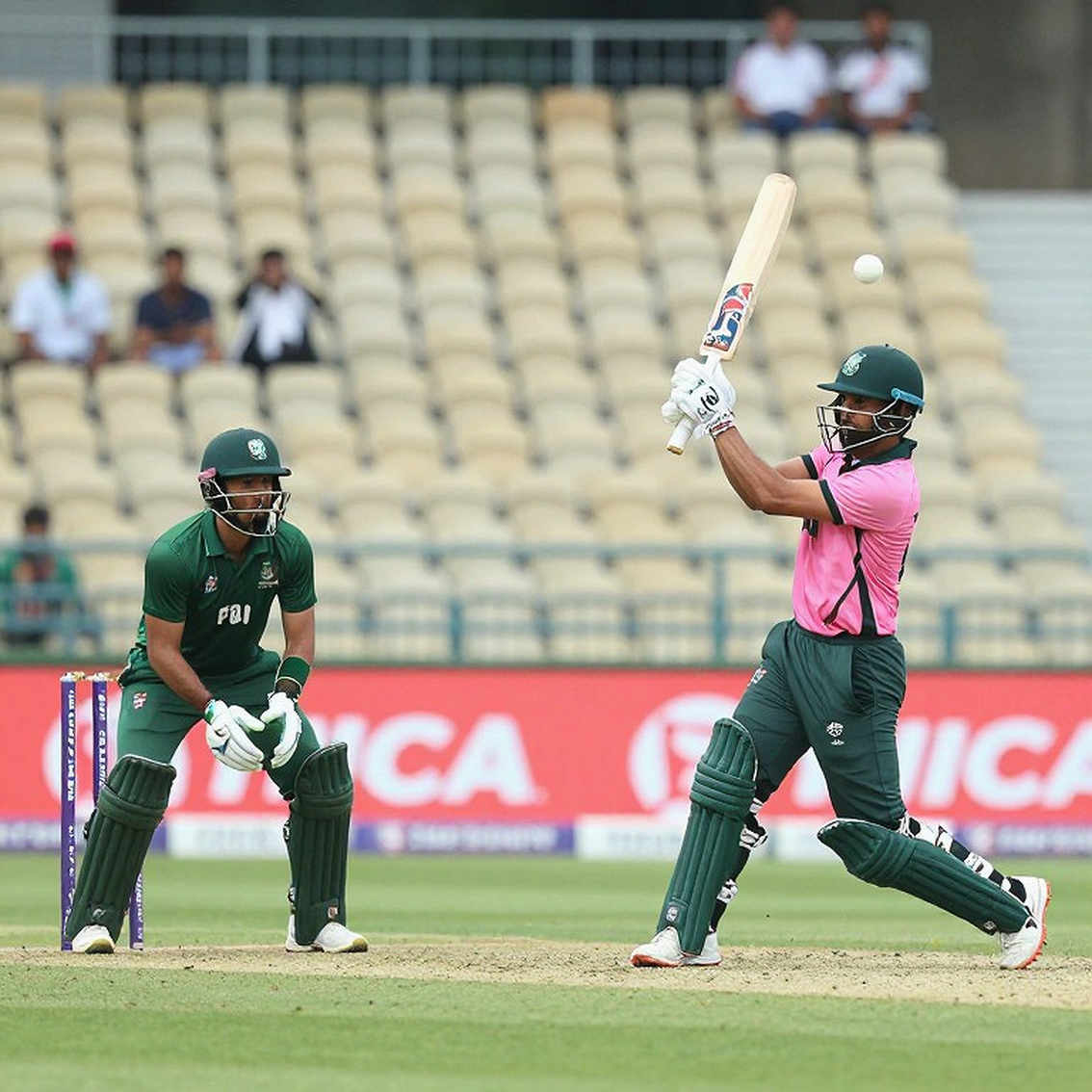
Second, Chase's captaincy. The card tells you who the captain is; it does not tell you how he captains. His review was well timed and his spin rotation was sound. Anything beyond that is inference.
Third, Shadman's night. Ninety-nine not out, a hotel room, a hard new ball in the morning. There is no model for that, and the people who build one usually get it wrong.
Takeaway: one binding call, with dates
I am filing a prediction, and you may hold me to it.
Bangladesh's first innings will not pass 340. The reason is not collapse but tempo: at 2.88 an over, another sixty overs are needed, and inside that window the new ball, Warrican's left-arm angle and an absent number five all arrive together. On that basis my second call is that this match trends towards a draw — measurable at stumps on day five.
There are three checkpoints. First: the opening hour of day two, with Shadman on 99 and the ball hard — the whole frame is decided inside fifteen overs. Second: the afternoon of day two, when we learn whether Hridoy returns in this innings; a non-appearance is the bigger story. Third: the cumulative overs lost at each stumps — if the total passes forty, the draw becomes the base case.
The Goa bubble did not burst; it deferred its wages and renamed the debt. Something on the same lines is happening at Mirpur. The scoreboard has announced 213 for 3. The payment date has been pushed back. And the date has always been the loudest thing on the page.